Modafinil vs. Bromantane: Which Is Better for Long-Term Mental Stamina?
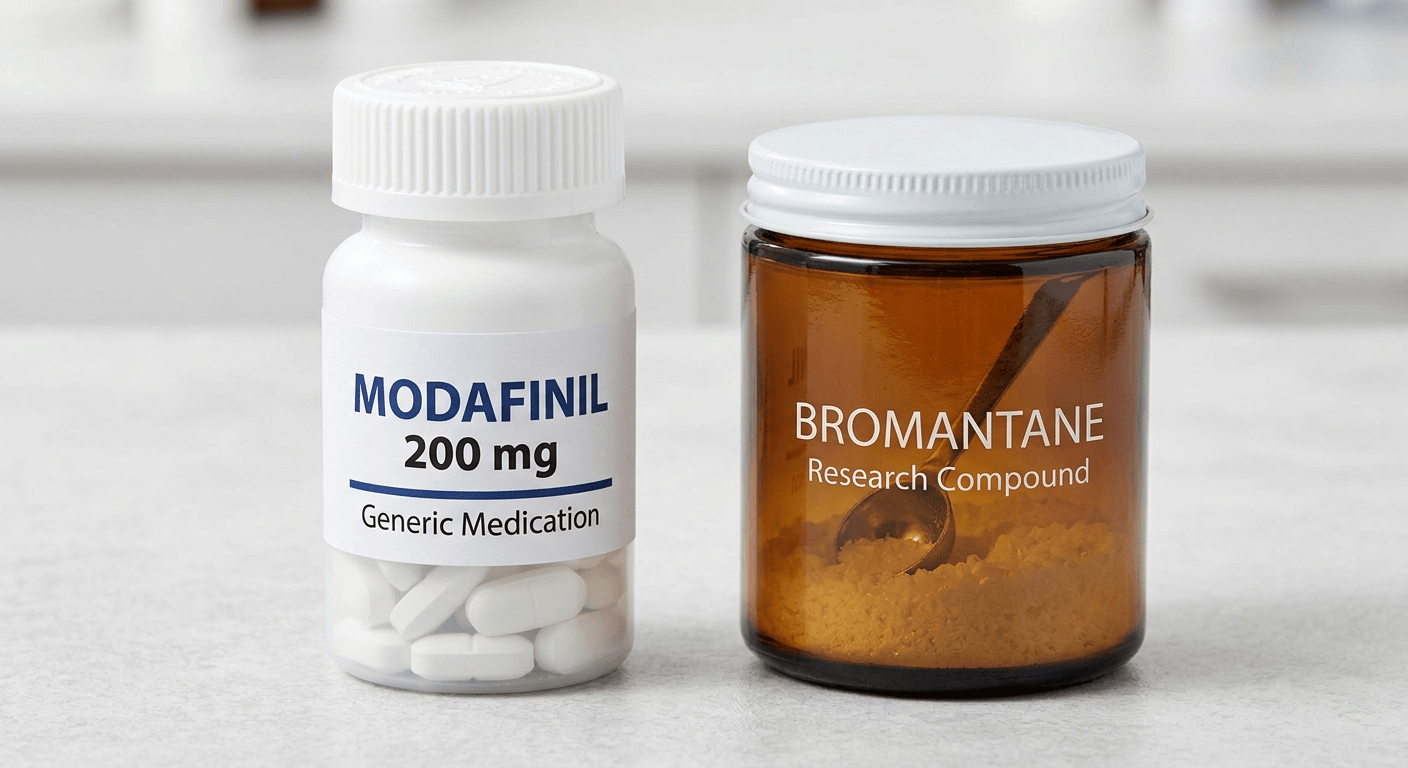
Modafinil and bromantane are often compared because both are used by people looking for better focus, stamina, and motivation. But they are not similar drugs.
Modafinil is a prescription wakefulness medication. It is approved in the United States for narcolepsy, obstructive sleep apnea, and shift work sleep disorder. It has a large clinical record, predictable dosing, and known safety warnings.
Bromantane is much less familiar outside nootropic circles. It was developed in the Soviet Union and is approved in Russia under the brand name Ladasten for neurasthenia, a condition involving fatigue, weakness, and anxiety. Outside Russia, it is not an approved medicine in most countries.
The practical difference is straightforward. Modafinil has stronger evidence when you need wakefulness and focus on a specific day. Bromantane may be more relevant when the problem is longer-term fatigue or low motivation, but it is harder to evaluate because the human evidence is thinner and sourcing is less reliable.

How Modafinil and Bromantane Affect Dopamine
The biggest difference between modafinil and bromantane is how they affect dopamine.
Modafinil mainly works by inhibiting the dopamine transporter, or DAT. This transporter helps clear dopamine after it has been released. When modafinil slows that process, dopamine signaling lasts longer.
That does not make modafinil the same as cocaine or methylphenidate. Modafinil has lower DAT affinity and a different pattern of brain activation. It tends to promote wakefulness without the same level of reward-circuit stimulation seen with stronger classical stimulants.
Modafinil also affects other systems involved in alertness, including norepinephrine, histamine, orexin, serotonin, and glutamate. That wider activity helps explain both its benefits and its side effects.
Bromantane appears to work farther upstream. Instead of mainly slowing dopamine clearance, animal studies suggest it increases the activity of enzymes involved in making dopamine, including tyrosine hydroxylase and aromatic L-amino acid decarboxylase.
In plain terms, modafinil helps dopamine signaling last longer after dopamine is released. Bromantane may help increase the brain’s ability to make dopamine.
That difference helps explain why modafinil tends to feel more immediate, while bromantane is often described as slower and more gradual. But it also highlights a major evidence gap: much of bromantane’s mechanism comes from animal research, while modafinil has been studied much more extensively in humans.
Modafinil: Better Studied and Faster Acting
Modafinil has the clearer evidence base.
A long-term open-label study followed 478 narcolepsy patients taking daily modafinil for 40 weeks and found no evidence that tolerance developed. The wakefulness-promoting effect remained stable without dose escalation.
A 2015 systematic review by Battleday and Brem found that modafinil improved performance in healthy, non-sleep-deprived subjects, especially on complex tasks. The most consistent benefits were seen in attention, planning, decision-making, and executive function.
That makes modafinil more useful for clear, demanding work: writing, coding, analysis, long study sessions, financial modelling, or high-pressure deadline work.
The effects are usually noticeable within 30 to 60 minutes. For many users, that is the appeal. Modafinil works on the day you take it.
But it is not a harmless productivity pill.
The main problem over time is sleep. Modafinil has a long half-life, usually around 12 to 15 hours. A dose taken in the late morning can still be active late at night. Even if a person can fall asleep, sleep quality may still suffer.
That matters because sleep is part of mental stamina. Poor sleep affects attention, mood, memory, and motivation. If modafinil helps you work longer but quietly damages your sleep, the benefit can shrink over time.
So the concern is not simply that modafinil stops working. The concern is that frequent or poorly timed use can interfere with recovery.
For that reason, modafinil is usually better suited to selected days, morning dosing, and medical supervision rather than casual daily use.
Bromantane: Slower and Less Proven
Bromantane has a different profile.
It is not usually described as a sharp same-day stimulant. Its effects are often said to build gradually over several days of use. That fits with its proposed mechanism, but the human evidence is much smaller than modafinil’s.
The main clinical data come from Russian studies in people with asthenic or neurasthenic conditions. These are conditions involving fatigue, weakness, anxiety, and reduced functioning.
A 2009 randomized, placebo-controlled Russian study used bromantane at 50 to 100 mg daily for 28 days in patients with neurasthenia. Physician-rated improvement in fatigue appeared in 76 percent of cases. Reported benefits in mood, motivation, and sleep quality also persisted for a month after treatment ended.
A larger multicenter Russian study involving 728 patients also reported benefits and relatively low rates of side effects.
Those findings are interesting, but they should not be overstated.
The studies were not mainly done in healthy professionals using bromantane for productivity. The research base is also concentrated in Russia, with limited independent replication elsewhere. That makes bromantane harder to evaluate than modafinil.
Bromantane may be more relevant for people thinking about longer-term fatigue, low drive, or stress-related depletion. But it is not as well proven, not widely approved, and not as easy to source reliably.
What Each One Is Better Suited For
Modafinil is better suited to days when you need a clear increase in wakefulness and focus.
It may be useful when a person has a major deadline, a long work session, or a period of sleepiness that interferes with performance. Its strengths are speed, predictability, and stronger human evidence.
Its downsides are also clear. It can cause insomnia, anxiety, appetite changes, headache, irritability, and drug interactions. The long half-life is especially important because sleep disruption can build slowly over repeated use.
Bromantane is better matched to a different question: not “How do I stay awake today?” but “Why do I feel depleted, unmotivated, or mentally worn down over time?”
That does not mean bromantane is the better choice. It means the reason people consider it is different.
The appeal of bromantane is not a sudden push. It is the possibility of gradual improvement in fatigue, motivation, and stress tolerance. The weakness is that this possibility rests on a thinner body of evidence.
So the practical tradeoff is simple.
Modafinil is more predictable when obtained legally by prescription because the dose and quality are controlled.
Bromantane is less predictable because it is not approved in most countries and online products may vary in purity and dose accuracy.
Access, Legality, and Product Quality
The legal and quality-control differences are important.
In the United States, modafinil is a Schedule IV controlled substance. It is FDA-approved for narcolepsy, obstructive sleep apnea, and shift work sleep disorder. Doctors may prescribe it off-label in some cases, but possession without a valid prescription is illegal.
With a prescription, modafinil has one major advantage: the product is manufactured to pharmaceutical standards. The dose is known, the quality is controlled, and a clinician can check for drug interactions.
Bromantane is approved in Russia as Ladasten. It is not approved as a medicine in the United States, United Kingdom, Australia, or most other countries.
That creates a grey-market problem. Bromantane sold online may not always contain exactly what the label claims. Dose accuracy, purity, and batch consistency can vary. For a compound that may build over several days, inconsistent product quality can make the effects harder to interpret and the risks harder to judge.
Bromantane is also banned by the World Anti-Doping Agency. That matters for athletes and anyone subject to drug testing.
Which Is Better for Long-Term Mental Stamina?
For most readers, modafinil has the stronger overall case because it is better studied, faster acting, and available through a legal medical pathway.
It is especially useful when the goal is short-term wakefulness and focus: a demanding workday, a long study session, or a situation where sleepiness is the immediate problem.
But modafinil is not ideal as a casual daily productivity drug. Its long half-life can interfere with sleep, and poor sleep can undermine attention, mood, and motivation. Used too often or too late in the day, it can work against the very problem it is meant to solve.
Bromantane is more speculative. It may be more relevant when the issue is longer-term fatigue, low motivation, or stress-related depletion. Its proposed dopamine-synthesis mechanism is interesting, and Russian clinical studies report benefits in fatigue and mood.
But bromantane is harder to recommend with confidence. The human evidence is thinner, the research is less widely replicated, and product quality can vary outside regulated medical channels.
So the answer depends on the problem.
If the problem is same-day wakefulness and focus, modafinil is better supported.
If the problem is longer-term fatigue or low motivation, bromantane is interesting but much less certain.
Neither should be treated as a substitute for sleep, recovery, exercise, nutrition, or medical evaluation. Before using either one, it is worth speaking with a physician, especially if you take other medications. Modafinil has known drug interactions, including reduced effectiveness of hormonal contraceptives through CYP enzyme induction. Bromantane’s interaction profile in humans is much less clearly understood.
References
- Battleday, R. M., & Brem, A. K. (2015). Modafinil for cognitive neuroenhancement in healthy non-sleep-deprived subjects: A systematic review. European Neuropsychopharmacology, 25(11), 1865–1881. https://doi.org/10.1016/j.euroneuro.2015.07.028
- Drug Enforcement Administration. (1999, January 27). Schedules of controlled substances: Placement of modafinil into Schedule IV. Federal Register, 64(17). https://www.govinfo.gov/content/pkg/FR-1999-01-27/html/99-1791.htm
- Greenblatt, K., Adams, N., & Modestino, E. J. (2023). Modafinil. In StatPearls. StatPearls Publishing. https://www.ncbi.nlm.nih.gov/books/NBK531476/
- Grekhova, T. V., Gainetdinov, R. R., Sotnikova, T. D., Krasnykh, L. M., Kudrin, V. S., Sergeeva, S. A., & Morozov, I. S. (1995). The effect of bromantane, a new immunostimulant with psychostimulating action, on release and metabolism of dopamine in the dorsal striatum of freely moving rats: A microdialysis study. Bulletin of Experimental Biology and Medicine, 119(3), 294–296. https://doi.org/10.1007/BF02445840
- Medvedeva, L. A., Voznesenskaia, T. G., Fokina, N. M., & Kuleshova, O. N. (2011). Treatment of asthenic disorders in patients with psychoautonomic syndrome: Results of a multicenter study on efficacy and safety of ladasten. Zhurnal Nevrologii i Psikhiatrii imeni S.S. Korsakova, 111(1). https://pubmed.ncbi.nlm.nih.gov/21322821/
- Mereu, M., Bonci, A., Newman, A. H., & Tanda, G. (2013). The neurobiology of modafinil as an enhancer of cognitive performance and a potential treatment for substance use disorders. Psychopharmacology, 229(3), 415–434. https://doi.org/10.1007/s00213-013-3232-4
- Mitler, M. M., Harsh, J., Hirshkowitz, M., & Guilleminault, C. (2000). Long-term efficacy and safety of modafinil for the treatment of excessive daytime sleepiness associated with narcolepsy. Sleep Medicine, 1(3), 231–243. https://pubmed.ncbi.nlm.nih.gov/10828434/
- Neznamov, G. G., Siuniakov, S. A., Teleshova, E. S., Chumakov, D. V., Reutova, M. A., Siuniakov, T. S., Mametova, L. E., Dorofeeva, O. A., & Grishin, S. A. (2009). Ladasten, the new drug with psychostimulant and anxiolytic actions in treatment of neurasthenia: Results of the comparative clinical study with placebo. Zhurnal Nevrologii i Psikhiatrii imeni S.S. Korsakova, 109(5), 20–26. https://pubmed.ncbi.nlm.nih.gov/19491814/
- Oliynyk, S., & Oh, S. (2012). The pharmacology of actoprotectors: Practical application for improvement of mental and physical performance. Biomolecules & Therapeutics, 20(5), 446–456. https://doi.org/10.4062/biomolther.2012.20.5.446
- Orekhova, T. V., Terekhov, S. A., Kudrin, V. S., & Seredenin, S. B. (2007). The effects of ladasten on dopaminergic neurotransmission and hippocampal synaptic plasticity in rats. Neuropharmacology, 53(5), 601–608. https://doi.org/10.1016/j.neuropharm.2007.07.001