Modafinil vs. Bromantane: Which Is Better for Long-Term Mental Stamina?
The Real Question Isn’t Which One Works — It’s Which One Lasts
Most comparisons of modafinil and bromantane get stuck on the wrong question. They debate which compound hits harder, which one produces a cleaner focus, which one a biohacker on a podcast prefers. For someone using a cognitive enhancer occasionally, that framing makes sense. For someone whose livelihood depends on sustained mental output across weeks and months — the developer three weeks into a product sprint, the analyst who can’t afford an off week in Q4 — the only question that matters is durability.
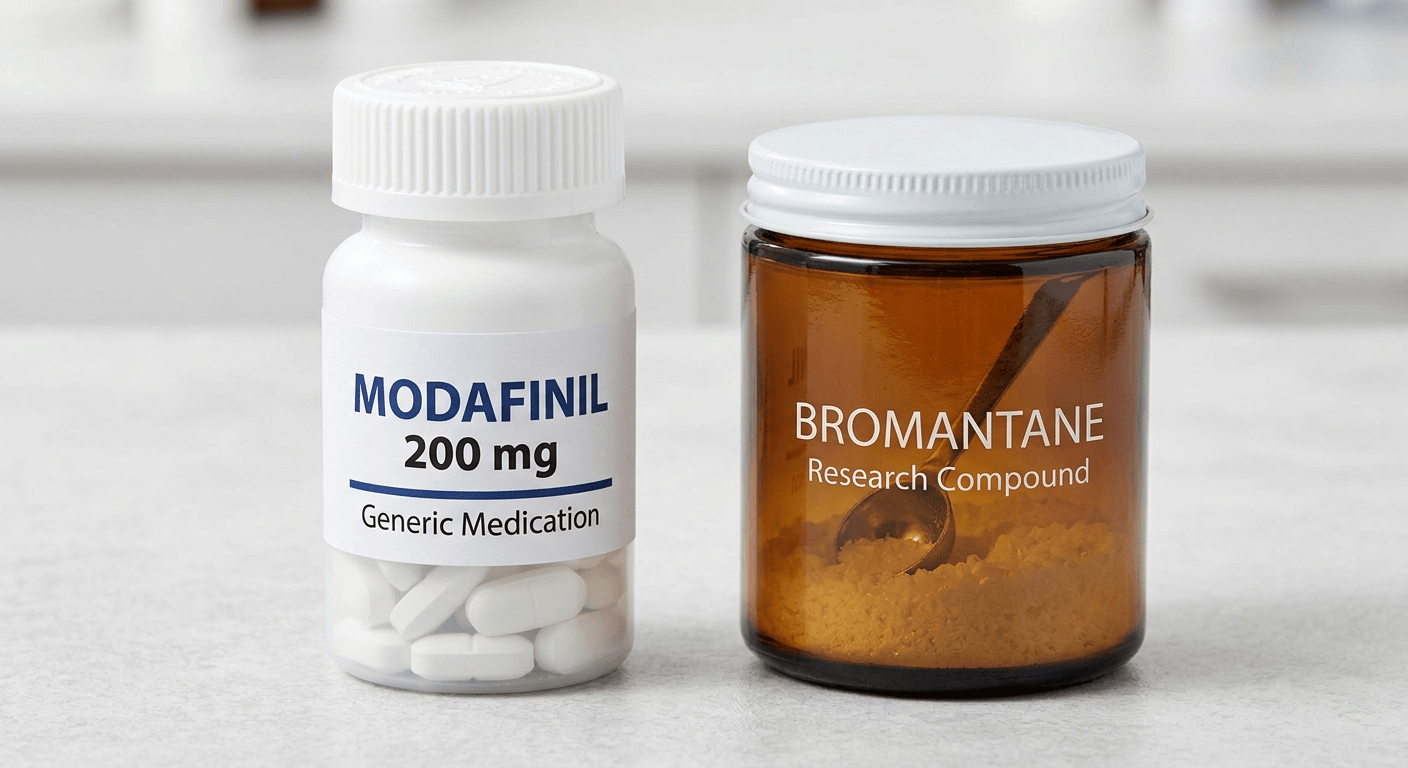
Modafinil is an FDA-approved wakefulness agent with two decades of research behind it and a well-earned reputation as the closest thing to a validated cognitive enhancer that mainstream science has produced. Bromantane is less familiar outside nootropic circles — a Soviet-era compound originally developed for military and space medicine, classified as an “actoprotector,” meaning it was designed to enhance performance under stress without the exhaustion rebound typical of stimulants. Its pharmacology is unlike anything else in common use.
The comparison that follows isn’t about which compound works. Both do. It’s about which one holds up.
How They Work — Two Very Different Relationships With Dopamine
The mechanistic difference between these two compounds isn’t a footnote — it’s the explanation for almost everything that follows.
Modafinil works primarily by inhibiting the dopamine transporter (DAT), the protein responsible for pulling dopamine back out of the synapse after release. Block the transporter, dopamine lingers longer, and the net effect is increased dopaminergic signaling across several brain regions — the prefrontal cortex, nucleus accumbens, and striatum among them. This is, in broad strokes, the same move that cocaine and methylphenidate make, though modafinil’s DAT affinity is considerably lower and its anatomical pattern of brain activation meaningfully different, favoring cortical over subcortical areas. The result is wakefulness and cognitive sharpening without the aggressive reward-circuit activation that makes classical stimulants prone to abuse. Modafinil also indirectly elevates norepinephrine, serotonin, histamine, and orexin — a wide neurochemical footprint that helps explain both its efficacy and the difficulty of pinning down exactly how it works.
Bromantane takes a different route entirely. Rather than managing dopamine at the synapse, it acts upstream at the genomic level, upregulating the expression of tyrosine hydroxylase (TH) and aromatic L-amino acid decarboxylase (AADC) — the two enzymes that govern dopamine synthesis. TH is the rate-limiting step: it converts L-tyrosine into L-DOPA, which AADC then converts into dopamine. A single oral dose produces roughly a 2–2.5-fold increase in TH expression in the rat hypothalamus within two hours, with corresponding increases in dopamine output across the hypothalamus, striatum, ventral tegmental area, and nucleus accumbens. Bromantane isn’t opening a faucet on a fixed tank — it’s expanding the tank’s production capacity.
That distinction matters more than it might initially seem. A compound that increases dopamine synthesis faces a fundamentally different tolerance dynamic than one that inhibits reuptake — and that difference plays out directly in long-term use.
Modafinil Over Time — Durable but Not Unlimited
The clinical record on modafinil’s long-term tolerance is more reassuring than most stimulants can claim. A 40-week open-label study following 478 narcolepsy patients on daily modafinil found no evidence of tolerance developing — wakefulness-promoting effects held steady across the full duration without dose escalation. A 2015 systematic review by Battleday and Brem, covering studies of modafinil in healthy non-sleep-deprived subjects, found that when complex cognitive tasks served as the benchmark, modafinil consistently enhanced attention, executive function, and learning, again without tolerance signals in controlled conditions.
The cognitive profile is worth being specific about. Modafinil’s most reliable effects land on decision-making, planning, and sustained attention under high cognitive load — exactly the functions that matter most for demanding knowledge work. Its effects on working memory are more variable, and a handful of studies find it can impair divergent thinking, the kind of associative, lateral cognition that creative problem-solving depends on. That’s not a dealbreaker for most professional use cases, but it’s worth knowing if your work sits closer to brainstorming than execution.
The more practical long-term constraint isn’t tolerance in the pharmacological sense — it’s sleep. Modafinil’s half-life runs 12 to 15 hours. Taken at 7am, it’s still active at 7pm. Taken at 10am, meaningful concentrations persist past midnight. For anyone relying on quality sleep as part of their cognitive recovery, daily modafinil use without careful timing creates a slow-building deficit that erodes the very performance it’s meant to support. Insomnia is the most commonly reported adverse effect in off-label users, appearing in roughly 5 to 10 percent of cases — a number that climbs with afternoon dosing and higher doses.
None of this disqualifies modafinil for long-term use. It means that long-term modafinil use requires active management — consistent morning dosing, non-daily scheduling, and honest accounting of sleep quality — rather than treating it as infrastructure that runs quietly in the background.
Bromantane Over Time — The Slow Build
Bromantane’s long-term profile looks the way it does precisely because of its mechanism. When a compound enhances dopamine by upregulating the enzymes that synthesize it, the brain’s own feedback systems remain largely intact — there’s no surplus of synaptic dopamine triggering receptor downregulation, no depletion of stored neurotransmitter driving a post-dose crash. Animal studies with extended bromantane exposure find no tolerance development and no dependence, consistent with a mechanism that works with the brain’s regulatory architecture rather than around it.
The human data, while narrower, points in the same direction. A randomized, placebo-controlled trial published in 2009 followed patients with neurasthenia — chronic fatigue with anxiety, a condition that maps reasonably well onto the cognitive depletion state many high-output professionals recognize — across 28 days of bromantane at 50 to 100 mg daily. Physician-rated improvement in fatigue appeared in 76 percent of cases. More striking was what happened after the drug stopped: benefits in mood, motivation, and sleep quality persisted for a full month following discontinuation. A larger multicenter Russian trial enrolling 728 patients across 28 clinical centers confirmed both the efficacy and durability, with adverse effects in only 3 percent of patients and treatment discontinuation due to side effects in under 1 percent.
That post-discontinuation persistence is the genomic mechanism playing out in practice. TH mRNA upregulation doesn’t simply switch off when the compound clears — the increased enzyme expression lingers, sustaining elevated dopamine synthesis capacity beyond the dosing window. Effects build over the first five to seven days of consistent use, which means first-day impressions reliably underrepresent what bromantane actually delivers.
Two caveats deserve explicit mention. First, bromantane’s human evidence base is concentrated almost entirely in Russian clinical research, conducted in patient populations with asthenic disorders rather than healthy, high-functioning professionals. Independent replication in Western research settings is essentially absent. Second, bromantane potentiates GABAergic signaling — reducing expression of GABA transporters — which contributes to its anxiolytic effect but also means its full profile in varied neurochemical contexts isn’t well characterized. It’s a compound with a pharmacology worth taking seriously and a real but incomplete evidence base.
The Practical Difference — What Each Compound Actually Feels Like to Use
Mechanism explains the pharmacology. It doesn’t tell you what Tuesday morning feels like on each compound, or how to fit either one into a working week without it eventually working against you.
Modafinil is an on-demand tool. It reaches meaningful plasma concentrations within 30 to 60 minutes of oral dosing, delivers a reliable alerting effect, and works on any given day regardless of how many days precede it. That consistency is useful — when a deadline compresses your schedule or a run of bad sleep has left you running on fumes, modafinil reliably closes the gap. Its cognitive lift is pronounced and directive: it narrows attention, raises the cost of distraction, and makes sustained work on a single complex problem feel less effortful. For developers debugging a gnarly system, analysts building models, or founders grinding through financial projections, that profile fits well.
The tradeoffs are real. The same alerting quality that makes modafinil useful can tip into edginess in people who already run anxious, particularly at the 200mg dose. Its 12 to 15 hour half-life means afternoon dosing reliably borrows against tomorrow’s sleep — a trade that makes sense occasionally but compounds badly over weeks. The most sustainable protocols in cognitively demanding professional contexts tend toward two to four days per week, morning dosing only, with deliberate off-days rather than daily administration.
Bromantane feels different in almost every respect. The onset is gradual — effects build across the first week of consistent use rather than announcing themselves within the hour. What users and the clinical literature both describe is less a stimulant effect than a restoration of baseline: motivation that feels earned rather than borrowed, a reduction in the friction that makes starting hard tasks difficult, and a calm that coexists with the drive rather than competing with it. The anxiolytic component is clinically documented and practically meaningful — bromantane is one of the rare compounds that raises dopaminergic tone without raising cortisol-adjacent tension. For people whose cognitive performance degrades under pressure partly because anxiety compounds the load, that combination is harder to find than it sounds.
The clinical dosing range established in trials is 50 to 100 mg daily, taken in the morning. Unlike modafinil, its shorter effective half-life and GABAergic profile carry no meaningful sleep disruption risk at standard doses. The tradeoff is that it demands patience — and a reliable source, which is a non-trivial constraint given its regulatory status outside Russia.
Neither compound rewards habitual use over deliberate use. The difference is that modafinil rewards you immediately and requires discipline to sustain, while bromantane requires discipline upfront and rewards you over time.
Access, Legality, and What You’re Actually Getting
The practical reality of using either compound long-term isn’t just pharmacological — it’s logistical.
Modafinil is Schedule IV in the United States, FDA-approved for narcolepsy, obstructive sleep apnea, and shift work sleep disorder. A prescription means pharmaceutical-grade manufacturing, known purity, and consistent dosing. Off-label prescribing is legal and practiced. Possession without a valid prescription is a federal offense. The legal pathway is navigable; the gray-market pathway carries both legal and quality-control risk that compounds over time.
Bromantane is approved in Russia under the brand name Ladasten for neurasthenia treatment and has no regulatory approval elsewhere. In the United States it is unscheduled — not a controlled substance, not approved, simply absent from the regulatory framework — which places it in the gray zone occupied by research chemicals. Purity, dosing accuracy, and batch consistency vary by supplier in ways that matter when the compound’s effects are dose-dependent and build over days. It has been banned by the World Anti-Doping Agency since 1997, with urinary metabolites detectable for up to two weeks.
For long-term use, this asymmetry is consequential. Modafinil’s sourcing is controlled and consistent. Bromantane’s is not, and that variability introduces a real confound into any attempt to build a reliable long-term protocol.
Which One, Then?
The evidence doesn’t support a ranking — it supports a framework.
Modafinil is the stronger acute tool. It works on day one, its cognitive effects are well-characterized across dozens of controlled studies, it’s legally obtainable with a prescription, and pharmaceutical manufacturing means you know what you’re putting in your body. For professionals who need a reliable performance floor on high-stakes days — a critical presentation, a 14-hour sprint, a week of back-to-back deadlines — modafinil delivers that with a consistency bromantane can’t match on short notice. Morning dosing, non-daily use, and honest attention to sleep quality keep its long-term profile favorable. Use it as a precision instrument rather than daily infrastructure and it holds up well.
Bromantane is the better long-arc investment. Its mechanism doesn’t deplete what it draws on, its clinical profile shows no tolerance development, its side effect burden is low, and the persistence of benefits after discontinuation suggests something closer to a genuine upregulation of baseline capacity than a temporary pharmacological override. For professionals whose challenge isn’t occasional peak performance but sustained output across months — maintaining motivation, keeping cognitive friction low, staying functional through the accumulation of stress that long projects generate — bromantane’s profile fits that problem more precisely. The evidence base is thinner and the sourcing harder, and both matter. But for users willing to navigate both, it offers something genuinely different from any other compound in common use.
The cleanest summary: reach for modafinil when you need reliable, on-demand cognitive support and have legal access to it. Consider bromantane when the goal is building a higher baseline over weeks or months, with the understanding that you’re working from a promising but incomplete evidence base, and that your results will only be as consistent as your sourcing discipline.
Before starting either compound, a conversation with a physician is worth having — not as a formality, but because modafinil carries real drug interactions including significant effects on hormonal contraceptives via CYP enzyme induction, and bromantane’s interaction profile in humans remains incompletely mapped. Both compounds are tools. One is faster and better studied; the other is slower and more architecturally interesting. Which you reach for depends on whether your problem is acute or chronic — and whether you have the patience the slower one requires.
References
Mereu, M., Bonci, A., Newman, A. H., & Tanda, G. (2013). The neurobiology of modafinil as an enhancer of cognitive performance and a potential treatment for substance use disorders. Psychopharmacology (Berl), 229(3), 415–434.
https://doi.org/10.1007/s00213-013-3232-4
Oliynyk, S., & Oh, S. (2012). The pharmacology of actoprotectors: practical application for improvement of mental and physical performance. Biomolecules & Therapeutics, 20(5), 446–456.
https://doi.org/10.4062/biomolther.2012.20.5.446
Battleday, R. M., & Brem, A. K. (2015). Modafinil for cognitive neuroenhancement in healthy non-sleep-deprived subjects: a systematic review. European Neuropsychopharmacology, 25(11), 1865–1881.
https://doi.org/10.1016/j.euroneuro.2015.07.028
Mitler, M. M., Harsh, J., Hirshkowitz, M., & Guilleminault, C. (2000). Long-term efficacy and safety of modafinil (Provigil) for the treatment of excessive daytime sleepiness associated with narcolepsy. Sleep Medicine, 1(3), 231–243.
https://pubmed.ncbi.nlm.nih.gov/10828434/
Neznamov, G. G., Siuniakov, S. A., Teleshova, E. S., Chumakov, D. V., Reutova, M. A., Siuniakov, T. S., Mametova, L. E., Dorofeeva, O. A., & Grishin, S. A. (2009). Ladasten, the new drug with psychostimulant and anxiolytic actions in treatment of neurasthenia: results of the comparative clinical study with placebo. Zhurnal Nevrologii i Psikhiatrii imeni S.S. Korsakova, 109(5), 20–26.
https://pubmed.ncbi.nlm.nih.gov/19491814/
Medvedeva, L. A., et al. (2011). Treatment of asthenic disorders in patients with psychoautonomic syndrome: results of a multicenter study on efficacy and safety of ladasten. Zhurnal Nevrologii i Psikhiatrii imeni S.S. Korsakova, 111(1).
https://pubmed.ncbi.nlm.nih.gov/21322821/
Grekhova, T. V., Gainetdinov, R. R., Sotnikova, T. D., et al. (1995). Effect of bromantane, a new immunostimulating agent with psychostimulating activity, on the release and metabolism of dopamine in the striatum of freely moving rats: a microdialysis study. Bulletin of Experimental Biology and Medicine, 119(3), 294–296.
https://doi.org/10.1007/BF02445840
Orekhova, T. V., et al. (2007). The effects of ladasten on dopaminergic neurotransmission and hippocampal synaptic plasticity in rats. Neuropharmacology, 53(5), 601–608.
https://doi.org/10.1016/j.neuropharm.2007.07.001
Benes, F. M., et al. (2023). Modafinil. StatPearls. National Center for Biotechnology Information.
https://www.ncbi.nlm.nih.gov/books/NBK531476/
Drug Enforcement Administration. (1999, January 27). Schedules of controlled substances: placement of modafinil into Schedule IV. Federal Register, 64(17).
https://www.govinfo.gov/content/pkg/FR-1999-01-27/html/99-1791.htm