Can Modafinil Cause Bone Loss or Impair Bone Formation?
Modafinil is usually discussed in relation to wakefulness, focus, sleep, appetite, anxiety, and insomnia. Bone health rarely comes up.
The concern comes from two preclinical studies: one in young rats and one in human bone-related cells.

The Two Studies
In 2018, Pal China et al. gave young male Sprague Dawley rats daily modafinil for five weeks and measured bone mass, bone structure, and bone strength. In 2022, Wagener et al. exposed human mesenchymal stem cells to modafinil and measured cell behavior in a lab dish rather than in a living organism.
The two studies point at different halves of the same process. Pal China et al. found evidence that modafinil increases bone resorption. Wagener et al. found evidence that it impairs bone-forming cell function. Together, they raise a question neither study can answer alone: could modafinil shift bone remodeling toward bone loss in people?
In Rats, Modafinil Reduced Bone Mass and Strength
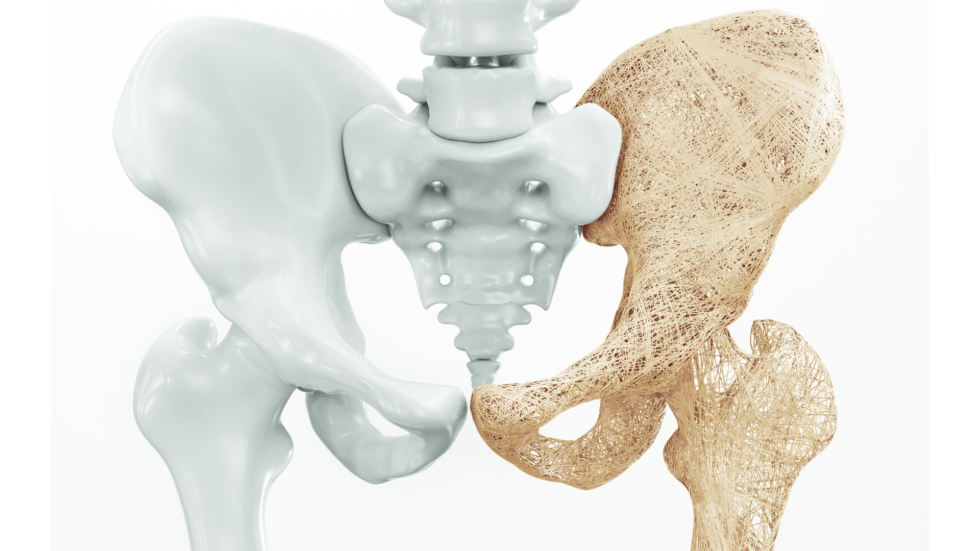
Pal China et al. found bone loss in both trabecular and cortical bone.
Trabecular bone is the spongier internal bone found near the ends of long bones. Cortical bone is the denser outer shell that provides much of a bone’s strength.
After five weeks of daily modafinil at 12 mg/kg per day, a dose the researchers described as human-equivalent to 100 mg/day, the rats had lower trabecular volumetric bone mineral density and lower trabecular bone volume in the femur and tibia (Pal China et al., 2018). Trabecular number decreased, while trabecular spacing increased, meaning the internal bone structure became thinner and more widely spaced.
Cortical bone was also affected. Modafinil reduced cortical bone mineral density, cortical thickness, bone area, and tissue area in the femur and tibia (Pal China et al., 2018).
Bone strength declined accordingly. In compression testing of the femur head, modafinil reduced maximum load, stiffness, and failure energy. In three-point bending tests of the femur shaft, it reduced load-bearing strength (Pal China et al., 2018).
The researchers also tested alendronate, an antiresorptive osteoporosis drug, alongside modafinil. Alendronate protected trabecular bone but did not fully protect cortical bone, suggesting modafinil’s effect was not confined to one bone tissue type (Pal China et al., 2018).
How Modafinil May Increase Bone Resorption
Bone is constantly remodeled: osteoblasts build it, osteoclasts break it down. Bone loss occurs when breakdown outpaces formation.
Pal China et al. found signs of high-turnover bone loss. Modafinil increased PINP, a bone formation marker, and CTX-1, a bone resorption marker. The rise in both suggests faster remodeling overall, with resorption strong enough to produce net loss (Pal China et al., 2018).
The key pathway was RANKL and OPG. RANKL promotes osteoclast formation and activity; OPG restrains it. A higher RANKL/OPG ratio shifts the balance toward more resorption. In the rat study, modafinil increased this ratio along with osteoclast-related gene activity and TRAP-positive osteoclasts per bone surface (Pal China et al., 2018).
The researchers linked this to adenosine receptor signaling. In osteoblast experiments, modafinil raised cAMP and increased the RANKL/OPG ratio, and blocking adenosine A2A and A2B receptors reduced or reversed the effect (Pal China et al., 2018). The proposed mechanism: modafinil increases osteoblast-derived RANKL through adenosine receptor activity, which drives osteoclast activity and resorption.
In Human Cells, Modafinil Reduced Mineralized Matrix Formation
Wagener et al. exposed human mesenchymal stem cells to modafinil at 11.2 µg/mL, a concentration based on therapeutic plasma levels. After 28 days of osteogenic induction, modafinil-treated cells showed significantly less Alizarin red staining, a marker of extracellular calcium deposition, than differentiated control cells (Wagener et al., 2022).
This is the central evidence for impaired bone formation: reduced mineralized matrix formation in human bone-related cells under lab conditions. It does not show impaired bone formation in a living person.
Modafinil Also Impaired Stem Cell Migration
Wagener et al. separately found that modafinil impaired mesenchymal stem cell migration. Migration matters because these cells need to move during bone formation, remodeling, repair, and healing.
The effect appeared linked to beta-2 adrenergic signaling. The study found high beta-2 adrenoreceptor expression in human mesenchymal stem cells and osteoblasts, and a selective beta-2 receptor blocker rescued the migration deficit caused by modafinil and atomoxetine (Wagener et al., 2022). The study found no evidence of early apoptosis or secondary necrosis, so the concern is impaired cell function, not cell death.
Does This Prove Modafinil Causes Bone Loss in Humans?
No direct human study has shown that modafinil lowers bone mineral density, causes osteoporosis, or increases fracture risk.
The rat study used young animals, daily dosing, and five weeks of exposure. The human-equivalent dose calculation makes it relevant, but rat bone development isn’t identical to human bone development. The cell study used human tissue, but cell cultures don’t reproduce human metabolism, sex hormones, exercise, diet, calcium intake, vitamin D status, sleep, kidney function, or real-world dosing over years.
The accurate conclusion is narrow: modafinil caused bone loss in young rats and impaired bone-related cell function in vitro. Whether either effect occurs in humans taking the drug is unproven.
Who Should Pay More Attention
Pal China et al. focused on peak bone accrual, which is built during childhood, adolescence, and early adulthood. If modafinil affects that process in humans, the concern would be greatest for people still building or consolidating bone mass. Older users with osteoporosis risk factors may still have reason to ask about bone health.
The concern is also more relevant for people with existing bone-risk factors: low vitamin D, low calcium intake, low body weight, eating disorders, prior stress fractures, heavy endurance training, glucocorticoid use, thyroid disease, low sex hormones, or a family history of osteoporosis. None of this proves modafinil-related bone loss in any individual; it identifies who has more reason to raise the topic with a clinician.
Bone Pain Does Not Prove Bone Density Loss
Some online discussions connect modafinil use with bone pain during lifting or repetitive training. Bone pain isn’t a reliable way to detect low bone density; a person can’t feel bone mineral density dropping the way they’d feel a strained muscle.
Forearm pain during preacher curls, Scott curls, or other loaded arm movements can come from tendon irritation, muscle strain, periosteal irritation, repetitive loading, poor recovery, technique, or grip position. Persistent focal pain, especially pain that worsens with loading or returns in the same spot, warrants medical evaluation regardless of the cause.
Does This Mean Modafinil Users Need Bone Testing?
There is no modafinil-specific guideline recommending routine bone-density scans. A DEXA scan may be worth discussing with a clinician for anyone with prior low-trauma fractures, recurrent stress injuries, long-term steroid use, low body weight, an eating disorder, low vitamin D, an endocrine condition, or a family history of osteoporosis.
For an adult using modafinil occasionally, these two studies alone don’t establish a reason for routine testing. For a younger person using it regularly over years, particularly alongside other risk factors, the question is more reasonable, not because modafinil has been shown to cause osteoporosis, but because the overall risk profile may justify a baseline check.
Bottom Line
Modafinil has not been proven to cause bone loss in humans.
The concern comes from two preclinical findings. Pal China et al. found that daily modafinil reduced bone mass and strength in young rats. Wagener et al. found that modafinil reduced mineralized matrix formation and impaired mesenchymal stem cell migration in human bone-related cells.
Together, these studies suggest a plausible bone-health concern, especially for younger long-term users and people with existing bone-risk factors. They do not show that modafinil causes osteoporosis, fractures, or measurable bone loss in people.
The missing evidence is a human study tracking bone density, fracture risk, or bone turnover markers in long-term modafinil users.
FAQs
Can modafinil cause bone loss?
Not proven in humans. Pal China et al. found bone loss and reduced bone strength in young rats given daily modafinil, but animal findings don’t establish the same effect in people.
Can modafinil impair bone formation?
Wagener et al. found reduced mineralized matrix formation in human mesenchymal stem cells under lab conditions, which supports a possible effect on bone-forming cell behavior but doesn’t confirm it in living humans.
Is the rat dose comparable to human use?
Pal China et al. used 12 mg/kg per day in rats, described as a human-equivalent 100 mg/day dose. Species differences, dosing pattern, and exposure duration still limit how directly the finding translates.
Should long-term users worry?
Long-term users shouldn’t assume bone loss. Younger long-term users, and those with existing bone-risk factors, have more reason to raise it with a clinician.
Does bone pain mean modafinil is weakening my bones?
No. Exercise-related bone pain has many causes and isn’t a reliable indicator of bone density. Persistent or worsening focal pain should be medically assessed regardless of suspected cause.
References
Pal China, S., Pal, S., Chattopadhyay, S., Porwal, K., Mittal, M., Sanyal, S., & Chattopadhyay, N. (2018). The wakefulness promoting drug modafinil causes adenosine receptor-mediated upregulation of receptor activator of nuclear factor κB ligand in osteoblasts: Negative impact of the drug on peak bone accrual in rats. Toxicology and Applied Pharmacology, 348, 22–31. https://doi.org/10.1016/j.taap.2018.04.006
Wagener, N., Lehmann, W., Weiser, L., Jäckle, K., Di Fazio, P., Schilling, A. F., & Böker, K. O. (2022). Psychostimulants modafinil, atomoxetine and guanfacine impair bone cell differentiation and MSC migration. International Journal of Molecular Sciences, 23(18), Article 10257. https://doi.org/10.3390/ijms231810257